
When people talk about semiconductors, most of the attention goes to the visible parts of the system: the CPU, the GPU, the XPU, the DRAM, the HBM, or the networking silicon. Much less attention goes to the components that make all of that hardware run together, whether that’s to do with things like power or in this case, clocks and timing. The thing is, every modern electronic system needs timing. It needs a stable reference frequency so that each of the processors work together – but not just the processors, also the communications links, the memory subsystems, the sensors, and everything else all needs to know exactly when to send, receive, switch, and compute. Without that timing backbone, the rest of the system does not work properly. It is one of the least understood areas of chip design and system design outside of the engineers who build with it. It’s one of those weird analog/digital crossovers that only wizards seem to understand.
In terms of a history lesson, for decades, much of that timing market was built around quartz based devices. We’d cut and polish crystals to hit given frequencies. But as modern systems have become faster, smaller, more power sensitive, and more demanding in terms of resilience and precision, timing has had to evolve with them. That is where MEMS based timing comes in.
Instead of relying on a quartz crystal, companies like SiTime use silicon based Micro ElectroMechanical Systems to generate highly precise frequencies in a form that can be tuned, ruggedized, miniaturized, and optimized for a much broader set of use cases. That matters more today than ever, because of the growth of AI infrastructure. Not just the compute chips, but the optical networking especially is a big focus for the years ahead. There are also the autonomous systems, industrial platforms, and next generation communications that are increasing the need for better timing.
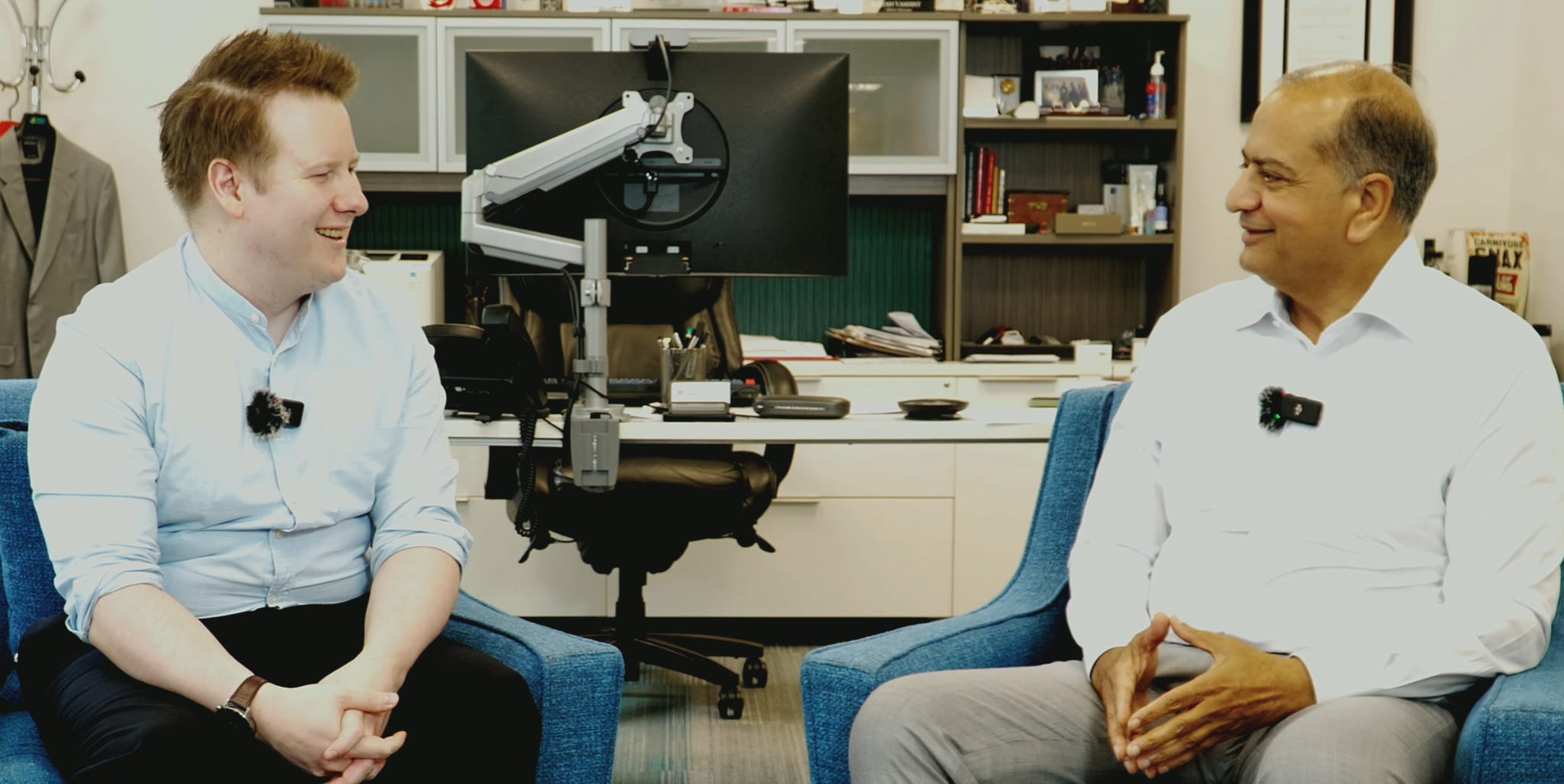
Joining me for this discussion is Rajesh Vashist, CEO of SiTime. I have covered the timing industry and SiTime before in 2024, but this conversation is an update on where the market is now, why timing is becoming a more visible part of the semiconductor story, and where SiTime sees its opportunity as demand rises for higher performance and more differentiated solutions.
In this interview, we talk about why timing is still unfamiliar to much of the wider chip audience despite being essential to every major system, where the current growth is coming from, how MEMS timing differs from traditional quartz, what AI and optical infrastructure are doing to demand, and how SiTime is thinking about competition, product development, and its planned expansion into broader clocking solutions.
The following is a transcription of the video interview, modified for readability.
Ian Cutress: This whole concept of MEMS’s timing isn’t new. As far as I’m aware, it’s been in smartphones for at least a decade in some form or another. Why is it important beyond what I’ve just said? Why is it important, particularly now?
Rajesh Vashist: It’s all about the importance of timing. When we went public in November 2019, it was still a fairly unknown market.
Most of the chips in the market are GPUs, XPUs, memory, Wi-Fi, and communications. That’s a big business. SiTime is in the timing business – which is an $11-12 billion market and it’s been growing 5-6% every year for the last 60-70 years. Timing is the heartbeat of all electronics, and the timing chip produces a frequency. Whether it’s a GPU or a CPU or a memory, it uses that to turn on or off at whatever level of performance that is needed.
So SiTime saw an opportunity almost 20 years ago to replace quartz with a semiconductor MEMS solution. MEMS means “micro electronic mechanical system”, which means essentially they’re moving parts but they’re moving in silicon. By definition because it is silicon, and because it’s one of the world’s most purest elements, brings a lot of technology to it. So we focused on it a long time ago. We competed with a lot of people, we beat them. We see more competition coming. But as of now we are the market leaders in these timing chips.
Ian Cutress: Whenever I see the diagram, I always remember like a butterfly vibrating its wings but at a constant beat. The devices in silicon actually kind of look a little bit like that don’t they?
Rajesh Vashist: They do! And ours are infinitesimally small. So when they’re packaged in the resonator, the chip is 0.5 by 0.5 mm. That is a packaged chip, and inside that is the vibrating element that you’re talking about, and this is 0.4 by 0.4 mm. It vibrates millions of times a second, at a Megahertz rate, and it does it for 30 years. That’s a minimum requirement for SiTime. So it’s incredibly resilient. There’s a lot of material science that goes on, there’s a lot of electronics that goes on, and we bring a lot of secret sauce in how to manufacture them.
Ian Cutress: The latest generation CPUs, GPUs, XPUs, and networking, where we’re dealing in gigabits or terabits per second- a portion of that market still uses quartz. Where do you see that going?
Rajesh Vashist: So we are a highly differentiated product, with highly differentiated performance, that enables a particular supply chain or resilience solution. So in other words, in our $12 billion market, we are not catering for $6 billion of it. The current solution suits them, and they don’t need the benefits we bring to the table. Out of the remaining market, we are still less than $1 billion. Last year we were $327 million. This year we’ve guided to something around 40-45% growth, Last year we were 60% growth.
My point here is that we are giving solutions that are high performance to wherever there is AI, wherever there is self driving, self-movement, wherever there is small size, wherever there are drones, or in consumer electronics like smart watches or smartphones that need a lot of performance. In general it’s a highly diversified business. We don’t have one market.
Yes, we have AI – that’s booming right now just like anything for anybody else. You mentioned going from 800G to 1.6T eventually it will go to 3.2T. SiTime is participating in all of that. We sell to probably 20 of the top OEMs in the business that are involved in that. But in AI, we sell to the XPU, the GPU, the TPU companies. We’re in the hyperscalers. We’re helping them define their architecture. We’re in the system OEMs and we are with a lot of the chip companies as well, the people who do switches and accelerator cards. So the AI business we guided last quarter that will probably be in the optical modules will probably grow by 50%. So hence it’s a lot of growth. But we also have automated driving. For example, in a Level 4 car, which is not really out in volume right now, we probably have $20 to $25, maybe $30 of content. Humanoid robotics, for when they happen, we’ll probably have, again, $20 of content. And then everything else is still a work in progress – the industrial markets, the internet of things, the consumer and so on.
Ian Cutress: Whenever I speak to a company that’s deeply embedded into the supply chain like you are, I often look at the financials and realize that most of the revenue comes from the 5-10 year old product. It is always a slow ramp with the latest generation to build to revenue. I can only assume that you’re seeing a more rapid onboarding of new products?
Rajesh Vashist: Our products used to take four-five years to ramp up, but now the ramp is down in some cases to nine months. In some cases it’s a little bit more sedate, 1.5 years. But we have consumer products that are ramping at astonishing levels within about a year to a year and a half.
Stepping back again, one of our board members sent us a forecast of the semiconductor industry going from approximately $750 billion to $1.6 trillion by 2030. 2030 is not that far away. That means the whole industry is going to grow by that much. Therefore you can imagine all these use cases are growing up and SiTime as a key player in that will definitely be involved in it.
Ian Cutress: Broadly speaking we categorize SiTime as a fab-less semi provider. So can you talk a little bit about your supply chain and how that comes about? You’re not using 2 nm, 3 nm logic processes if the end result is structures on the order of millimeters.
Rajesh Vashist: We are at heart an analog semiconductor company. This means like a Texas Instruments, like an Analog Devices, but that uses MEMS technology to build different systems. So our MEMS technology is made by Bosch. Bosch, in days of old, used to be an investor in SiTime and they’ve been a partner since I came on board in this company in 2007 before we had shipped any product. They’ve been a partner of SiTime since 2007 and maybe even a little bit earlier. They have a factory near Stuttgart where we manufacture all our MEMS. It all comes from there. They’re fantastic partners, and cutting edge. They do other MEMS technology and even though they’re not a merchant fab, it’s very helpful to us. They’re a little bit expensive but still really good for us. So that’s the MEMS part.
On the analog front, we rely heavily on TSMC. We always have, and as you said we’re not using 2 nanometers we’re using 180 nm, 150 nm, 65 nm. So what happens with that is it’s a little bit better, certainly cheaper (than leading edge). Then the tools that we use to design those products are not as expensive – tapeouts are significantly cheaper.
So these are building a MEMS product which is very craft oriented and an analog product which is very craft oriented, and putting the two together and making a small subsystem out of it for timing, for a customer. Because at the end of the day the customer has a timing problem and SiTime has set itself the task of solving these tough timing problems. Right now we solve it for the super big customers, but we also want to solve it for the long chain of people, our 100,000 customers, small OEMs who understand timing even less. So we focus on one thing and one thing only. We sing one song, but we sing it very well!
Ian Cutress: It’s interesting that you mentioned Bosch being this extensive manufacturing partner because at one time they were also a competitor?
Rajesh Vashist: No, they were actually never a competitor. You may recall they do other MEMS, they do gyroscopic MEMS. They do IMU MEMS but they were never “in time”.
Ian Cutress: So what does the competitive landscape look like? Because the material you feed me on a frequent basis describes something like a 2 year or even longer advantage over your competition.
Rajesh Vashist: I’ve been using that 2-year message on a rolling basis! It seems every year it’s two years away, so make of it what you will! But back in 2011-2012, SiTime competed with companies like Maxim, now ADI. We competed with Silicon Labs, now Skyworks. We competed with IDT, now Renesas. There were also a bunch of five or six small startups just like us because we were a startup. Luckily we were able to do better than all of them and they exited the business because they couldn’t handle it. Somebody gave me a number the other day that SiTime has invested close to $800 million in R&D. That’s what it takes to get this done. So if some competitors, maybe TI, maybe Analog Devices, maybe Murata, maybe ST. They might have plans to enter this market, but that’s at least half a billion that they’re going to have to spend to get into the business.
Ian Cutress: Coming from the outside, somebody who doesn’t come from timing, but has used it extensively in things like overclocking and such – that does sound like a lot of money for R&D!
Rajesh Vashist: It is! First of all, in MEMS alone, we have three ways to spend the money.
We have to build a process technology that is ours. Bosch doesn’t have a technology – it’s a SiTime technology we use in their fabs. We own the IP for the entire process, and we’re developing the sixth generation of that. So that means we have to develop it while we’re running it, while we’re running the fourth gen and the fifth gen. We’re developing not only the sixth, but also the seventh gen and eighth gen. So we have multiple process technologies that are running just for MEMS.
We also have the design of new MEMS. So that’s of course a big thing. That defines our products.
And finally we had to create our own EDA tools, our own design environment. We decided that we couldn’t find a design environment like a Cadence, like a Synopsys, like an Ansys, to do the job that we wanted. So we roll our own.
Rajesh Vashist: We have these three ways, but that’s just the MEMs.
On the analog side, we do our own design. We do our own layout. We do our own tapeouts. And these are some very cutting edge. For example, jitter as a metric. SiTime is already at 35 femtoseconds of jitter – we intend to get down to 15 femtoseconds. These are amazing numbers while at the same time keeping low power and small size. Putting these in packaging, like our OCXO packaging in our Epoch product – a package with two analog chips and three MEMS chips. That took more than a year to develop. For that design, we also have to do our own simulation because of thermal requirements and so on. That’s just in the technology part.
Then you go into marketing and sales. We try to hire people with a history of the timing market, but most of them haven’t ever sold a very distinguished or differentiated product like ours. So they didn’t know how to sell it. We’ve trained our own team to sell it.
Ian Cutress: You mentioned Renesas a little bit earlier and you’ve just started an acquisition on some of their business?
Rajesh Vashist: So while we are a clocking company and we do clocks which go in our oscillators along with our MEMS, we don’t have the same history as the other clocking companies who build it all together. We’ve always wanted to go to a customer, any customer, and give them the resonant frequency, the oscillators, and resonators, and also the clock all together.
We do that in a modest way today because we have got about 50 clocking products, but with Renesas we get 500 clocks. That’s a business which used to belong to IDT, and for those who recall it used to belong to a company called ICS which was taken public by Hock Tan in his glory days. So that business is now coming to SiTime. That gives us the ability to give a true system level solution to our customers particularly at the high end particularly at the differentiated level. We think it’s a game changer for customers because they don’t have to do the work – they have SiTime doing the work for them to make it an integrated system – either truly integrated physically or notionally integrated.
We’re very happy with that acquisition which has not yet gotten Department of Justice approval. We hope we’ll get it shortly because we think it’s pretty straightforward.
Ian Cutress: So how many people does that bring to the company and where are they located?
Rajesh Vashist: There are not that many people because all we’re getting is the engineers and some field application engineers. So we don’t get sales, we don’t get business, we don’t get any people in the business side. So we get around 150-155 people. Some of them are in Ottawa, Canada, some of them are here in the Bay Area in South San Jose and some are in Tempe, Arizona. They used to be all working for IDT. So in a sense, we’re bringing back an American company IP and technology back to the United States from Japan. That’s a good thing.
What it does is brings us customers in the clocking space. Renesas has been an amazing partner because not only are they selling us this but we would like to be able in future to enable their microcontroller business with our Titan based products, our resonator product. Now we only have a Letter of Intent so far, we don’t have the details yet, but we’d like to do that. What I really like about this is that their CEO Toshi Shibata has decided to join SiTime on the board as a board member of SiTime. We’re looking forward to having Toshi on board.
Ian Cutress: So potentially more markets beyond the $11 billion or is that included?
Rajesh Vashist: That’s included in it, but I think again we would be in the highly differentiated part of the resonator business. The resonator business is about $4-5 billion. We’d probably carve out a fifth of it, say $1 billion of it, in the small size high performance fully systematized business.
Ian Cutress: A little birdie told me that you’re in the process of moving offices because you have enough seats?
Rajesh Vashist: We are growing rapidly. We’re going to at the end of this year after the acquisition, we’ll probably be closer to between 700 to 800 people worldwide. We have around 13 locations. But here in Santa Clara, we’re going to move into a building which was the old ServiceNow building right on 101 in San Tomas. You’ll find us easily, we’re very excited about it. And we’re also moving to new offices in the Netherlands where we have a big location. We’re in Taiwan too, and probably some others as well. We’re also getting more lab space here in Santa Clara, that’s for all the lab guys at SiTime. They’re very excited about it because they’d like to be close to it. Right now we use a little bit of off the campus lab space.
Ian Cutress: When it comes to new product development – is it de novo thinking from your side trying to develop something new, or is it more the customer coming to you asking for extra features. Where’s the push and pull?
Rajesh Vashist: It’s more of a creativity exercise inside of SiTime first, because none of our customers actually know what is possible in timing!
Because timing has been frozen for so long they don’t know what is possible. Think of a Starbucks that when it started it produced an espresso, a latte and a cappuccino. Everybody knows what they are. But then they put out a frappuccino – nobody knew that a frappuccino was possible.
So in the same way our first step is with our engineers, our business people, our marketing people, our BU people, all sitting in a room and coming up with a highly differentiated problem that we can solve which is not yet solved for our customer. In many cases it cannot be solved without SiTime. So half of our products today are products that cannot be solved without any other solution. So highly differentiated.
The other is when once we put it out there, for example the OCXO that we put out, after the initial time of “oh my god you guys have this amazing product” customers say “well could you add this, could you add that.” So think of it as a new category product that comes from SiTime that then gets picked apart in a good way and becomes a better product or variations of that product and we love that kind of back and forth.
Ian Cutress: How do I know that something I’m using has a SiTime chip in it? This is one of the problems with embedded companies like yourself. You’re in that supply chain at such a point where you don’t really get any brand recognition.
Rajesh Vashist: Somebody asked me once a long time ago – would you rather get glory, or would you rather be rich? I thought that I’d rather be rich! But you can think of it this way – highly likely anywhere where there is significant AI, highly likely where there is significant autonomy. Think of a tractor on a farm, or drones. Highly likely in things that are super super super small, like watches and heartbeat monitors. Anywhere there’s a need for resiliency in communications, you’ll probably find SiTime. SiTime has shipped close to three billion units. This year we’ll ship about a billion units. Two years from now we’ll probably be shipping 3-4 billion units a year. The more differentiated the solution the more likely we are in it. That’s another way of thinking about it.
Ian Cutress: What does 2026 look like?
Rajesh Vashist: It looks like another amazing year, like 2025. I could even say that 2027 and 2028 probably look like amazing years! I think the long story on this is that we are in a place the world has never been in. I’ve been in semiconductors for 42 years and counting – I have never seen this. By the way, other semiconductor CEOs that I know have also not seen this. This is new territory – this is a place where we are leaving a mark that semiconductors really make the world different and they enable this world of smarts, communication, greater productivity, and that’s all built on semiconductors. So therefore we see a great future for the next five years really.
Ian Cutress: If there’s one thing you want the audience to know in general about timing given that probably most of the people watching are digital what would it be?
Rajesh Vashist: It would be that SiTime has created this technology, precision timing technology and we are a category creator. And like all category creators when they start, people don’t know what they are capable of. Think of when Amazon starts with selling books. Think of early Uber. Think of early Netflix.
People don’t understand, but the company does. In other words, listen to the company because when the company says they’re going somewhere, they’re highly likely a category creator is going there.
You can read the previous interview with Rajesh at the link below.
