
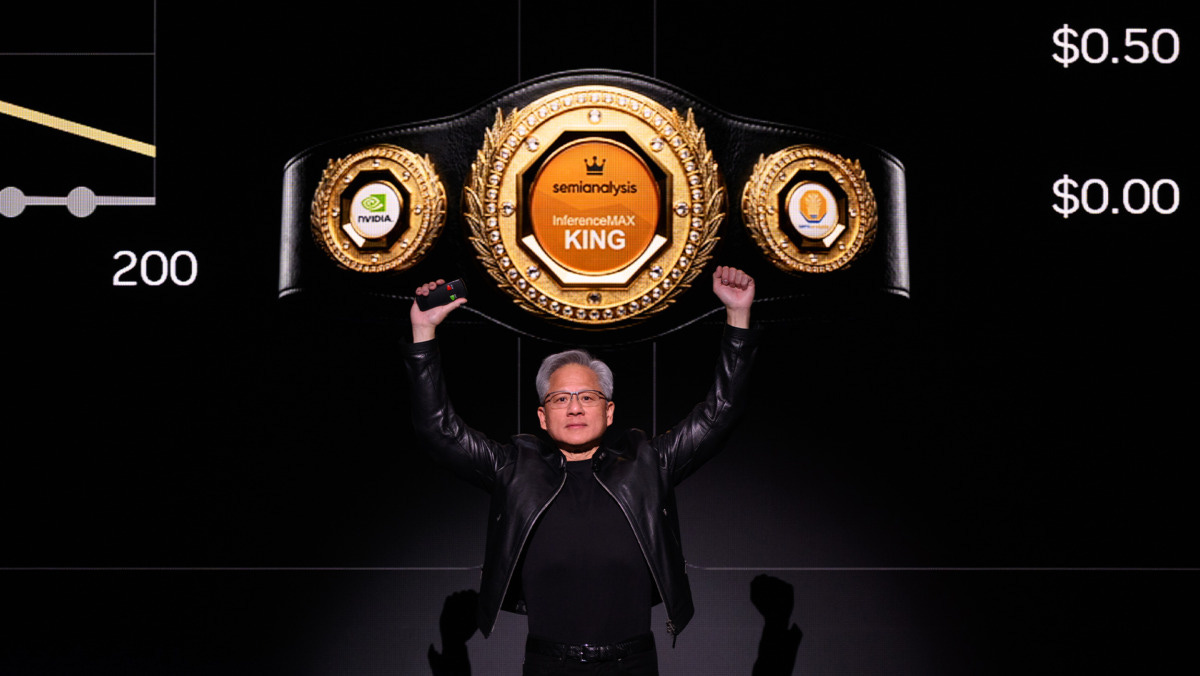
One of the more recent tour deforces in the semiconductor industry today is the analyst firm SemiAnalysis, headed up by CEO Dylan Patel and a team of around 50 employees all aimed at providing reports and models for the AI ecosystem – everything from datacenter build-out to supply-chain economics and deployments. The firm is relatively new on the stage, but quickly gained significant notoriety for its in-depth analysis and strong opinions, that over time was backed by substantial research. The substack for SemiAnalysis is the front facing part of the business, but the ca$50m+* revenue the company pulls in is mostly from selling its quarterly industry reports and other data features such as its InferenceX benchmarking and rating system for AI companies and datacenters. It’s at a point where Dylan and SemiAnalysis are referenced directly in NVIDIA keynotes and by people like Jim Cramer.
*This number has big error bars. I’ve tried to extrapolate it from data I once knew was correct…
The reason I’m writing this post today is because of a filing made in San Francisco County’s Superior Court. Former employee Wei Zhou is suing SemiAnalysis for, among other things, breach of contract and wrongful termination.
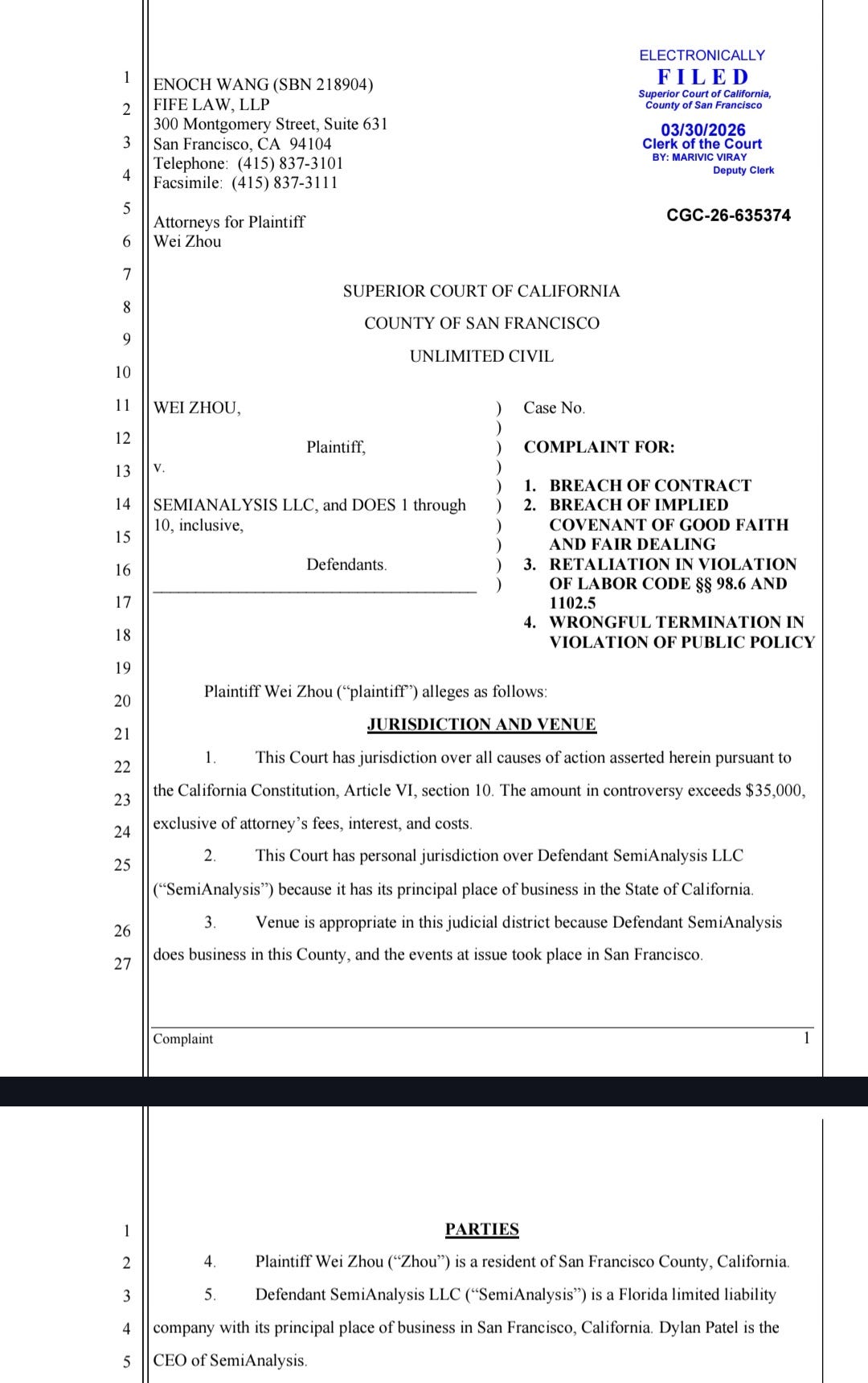
These are court filings CGC-36-635374.
The crux of the matter relates to how SemiAnalysis obtains its data for its reports. Firms like SemiAnalysis have to build reports based on data that is technically public. That doesn’t mean it’s freely available, for example if a company hands me a document or a presentation and tells me that it’s not under an embargo or NDA, that’s public information, but it’s just not widely distributed. Firms like SemiAnalysis obtain their data by filing information requests, looking through public shipping manifests, supply chain documentation, government documentation, or in the case of datacenter build-out analysis, even obtaining permission to fly drones over sites in order to get high quality images of what equipment is being used.
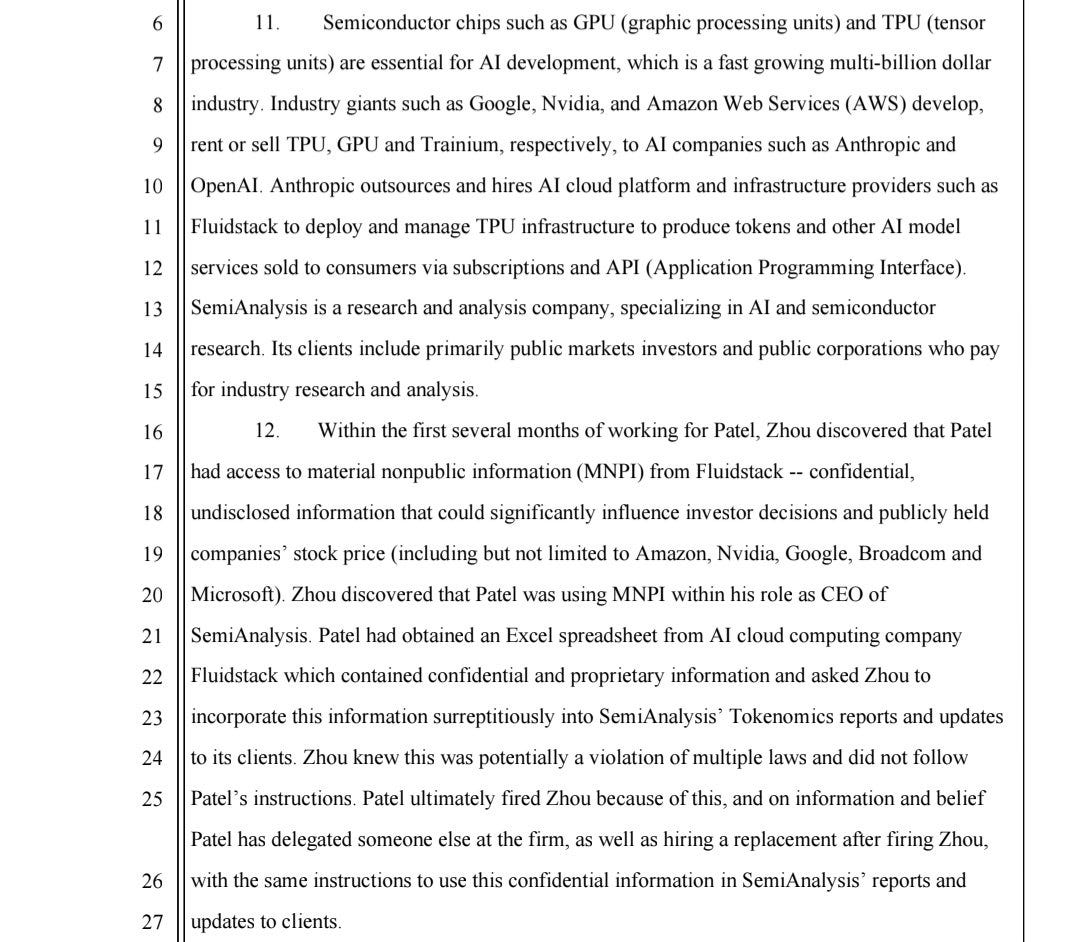
Zhou’s filing against SemiAnalysis boils down to the fact that when given material non-public information (MNPI) and told to incorporate it into the SemiAnalysis models that were then sold to clients (financial and in the semi industry), he refused to do so on the understanding it would break several laws. Zhou claims that as a retaliatory measure, Dylan/SemiAnalysis promptly fired him from the business, removing all access. To make matters worse, the MNPI was related to a $50m investment vehicle that Dylan Patel was in charge of personally, and Zhou highlighted that SemiAnalysis team members worked on this were doing so in company time. Zhou highlights that SemiAnalysis President, Doug O’Laughlin, had duties to stop the use of MNPI, but claims he was too busy fundraising for Patel’s investment vehicle.
The filing has several causes of action.
-
Breach of Contract
-
Breach of Implied Covenant of Good Faith and Fair Dealing
-
Retaliation in Violation of Labor Code §§ 98.6 and 1102.5
-
Wrongful Termination in Violation of Public Policy
No specific relief is requested at this time, however the filing indicates over $35,000.
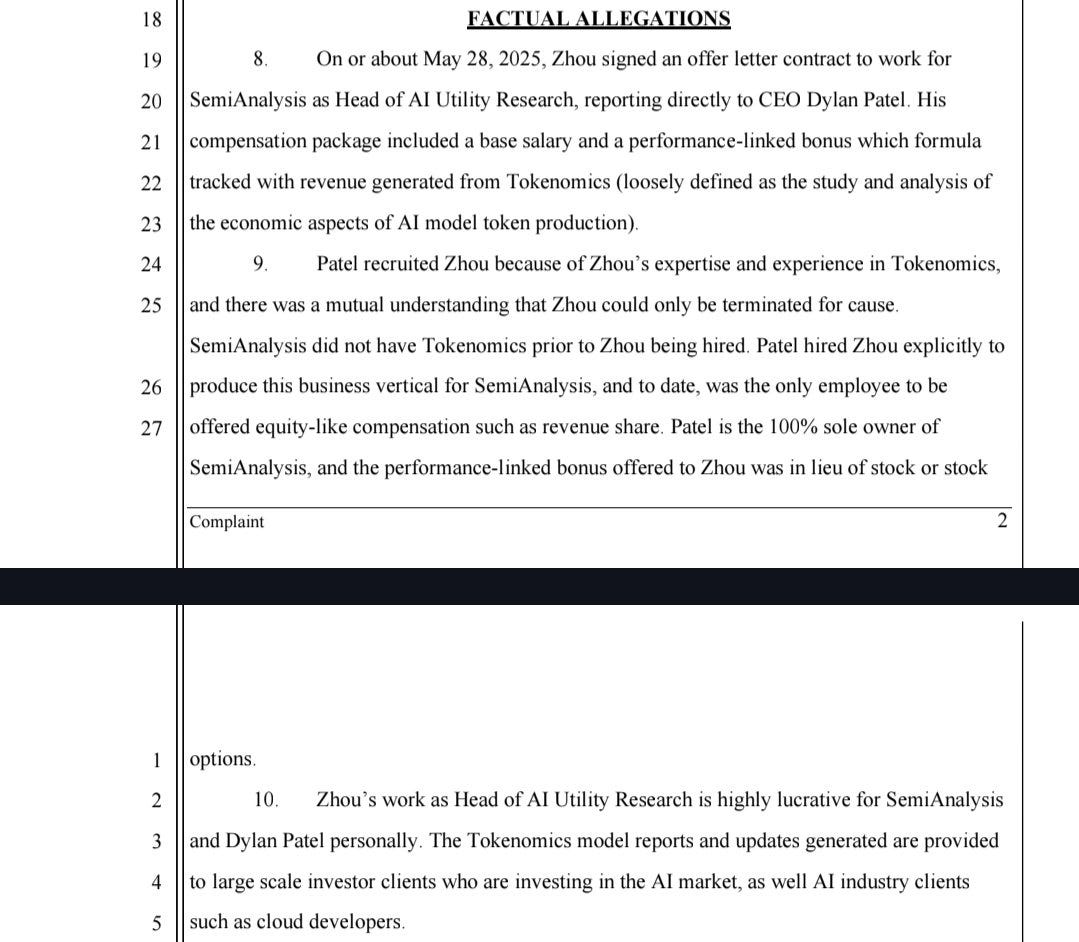
The other wrinkle in this filing is that Zhou was hired to build SemiAnalysis’ highly successful Tokenomics platform. Prior to Zhou’s employment, this did not exist, and in the filing Zhou claims that it was due to his expertise that it got of the ground – the success of Tokenomics lead to Zhou being one of the few employees to receive revenue share. It is explained in the filing that Dylan Patel is the sole owner of SemiAnalysis and there are no stock options/equity sharing with employees, highlighting the revenue share arrangement as a more unique situation within the company. Zhou has not directly requested relief based on this revenue share in this filing at this time.
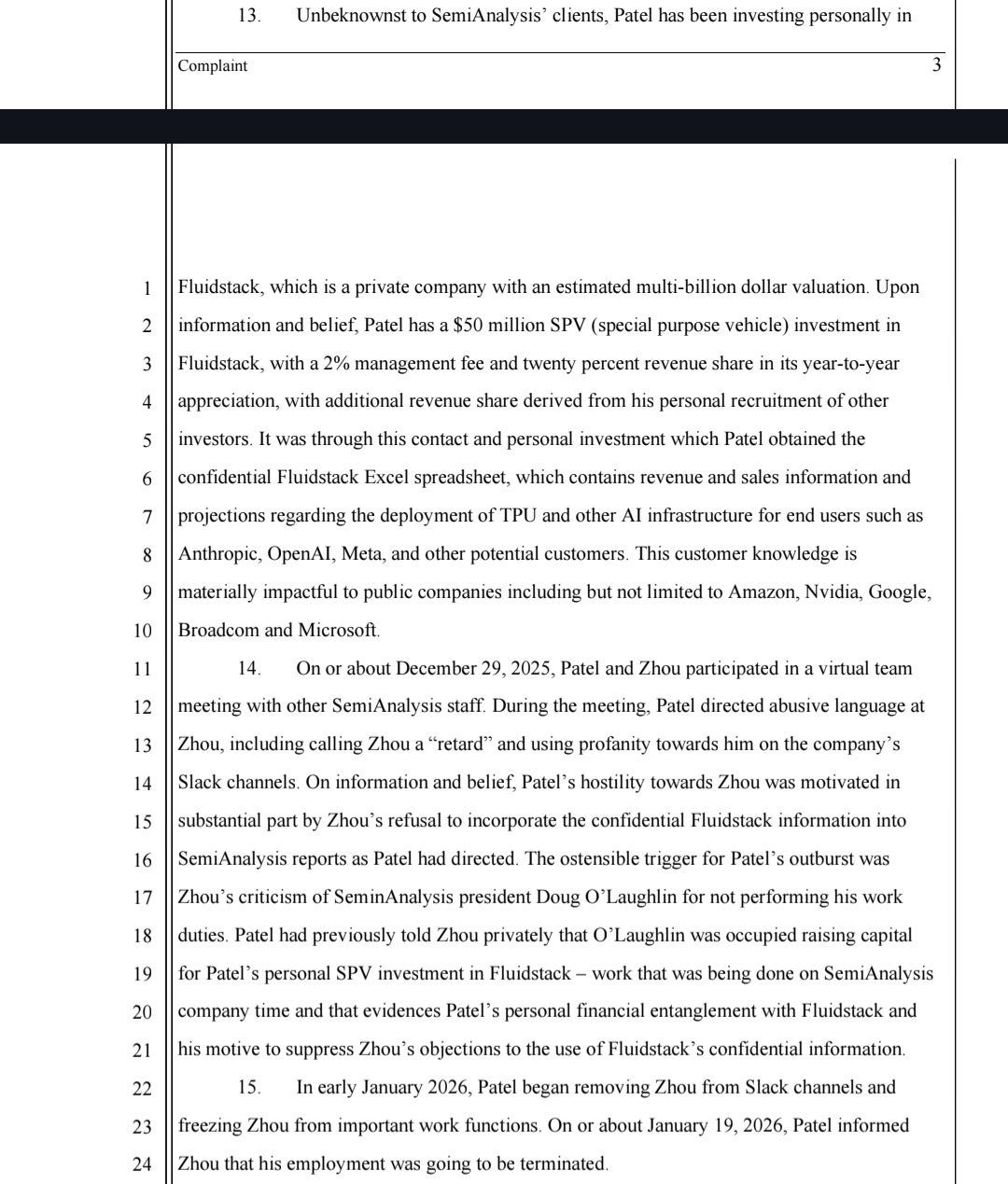
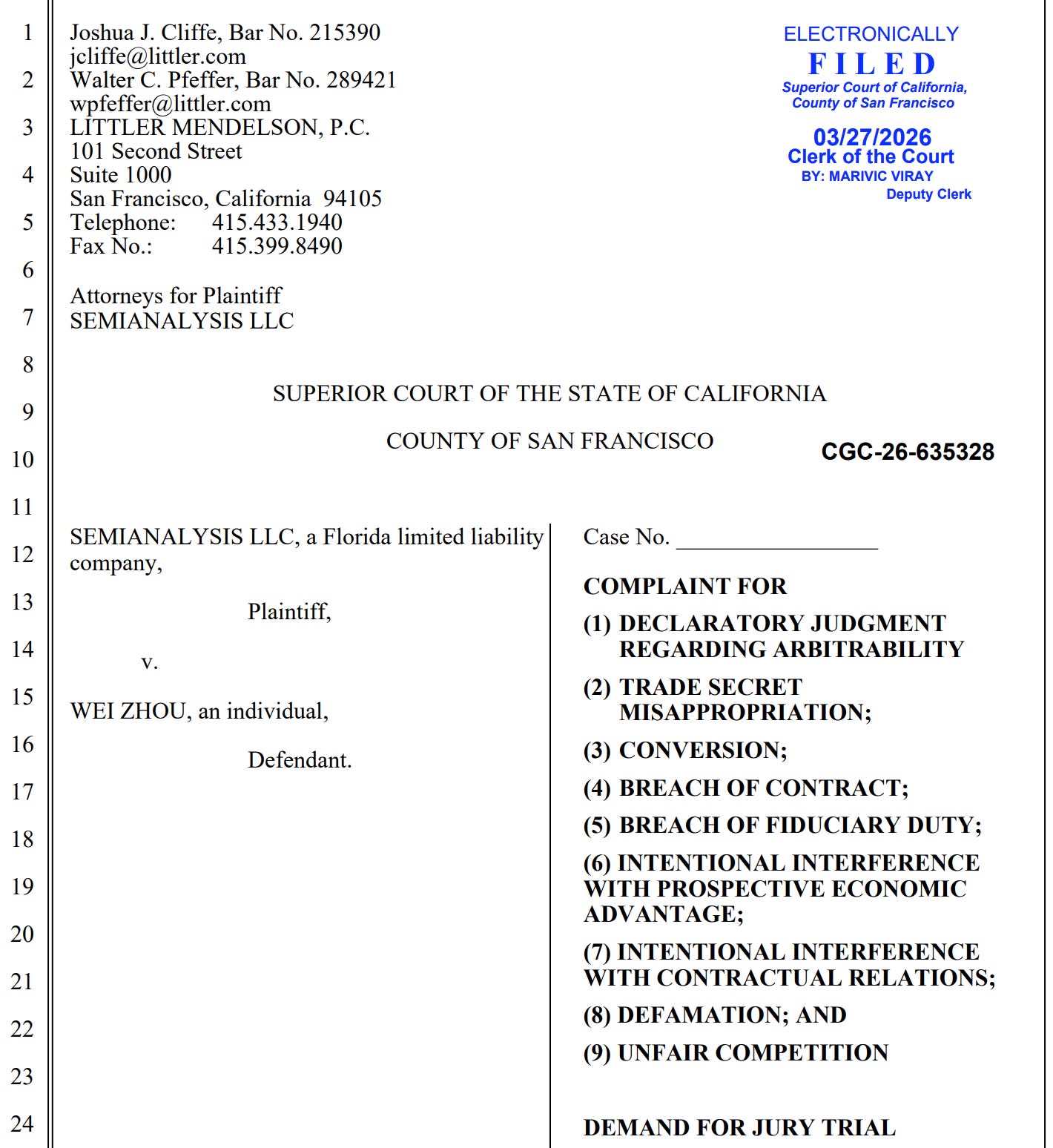
In order to get ahead of this filing it new was coming, SemiAnalysis has filed a counterclaim against Zhou, CGC-26-635328. The claim calls for a declaratory judgement and restitution based on trade secret misappropriation, conversion, breach of contract, breach of fiduciary duty, interference with prospective economic advantage, interference with contractual relations, and defamation.
In the introduction of this filing, SemiAnalysis claims that Zhou was terminated based on his professional conduct, citing, workplace disruption, inappropriate comments, alcohol issues, and refusal to work with specific individuals. The filing also claims that Zhou claimed his profit share worth was millions, with SA countering that Zhou’s employment contract would only pay should he remain employed by 1st April 2026. The filing goes on to state in no uncertain terms that ‘Zhou should have read his contract more carefully / Zhou’s allegations are [] in an attempt to extort money’. It also claims that Zhou has been making defamatory statements to SemiAnalysis customers and that Zhou still maintains in his possession a company laptop with trade secret information. The complaint later goes on to state that in order for SemiAnalysis to build its array of Trade Secrets, it enforces endpoint security on its employees devices, including encryption and multi-factor authentication such that only authorized personnel can access.
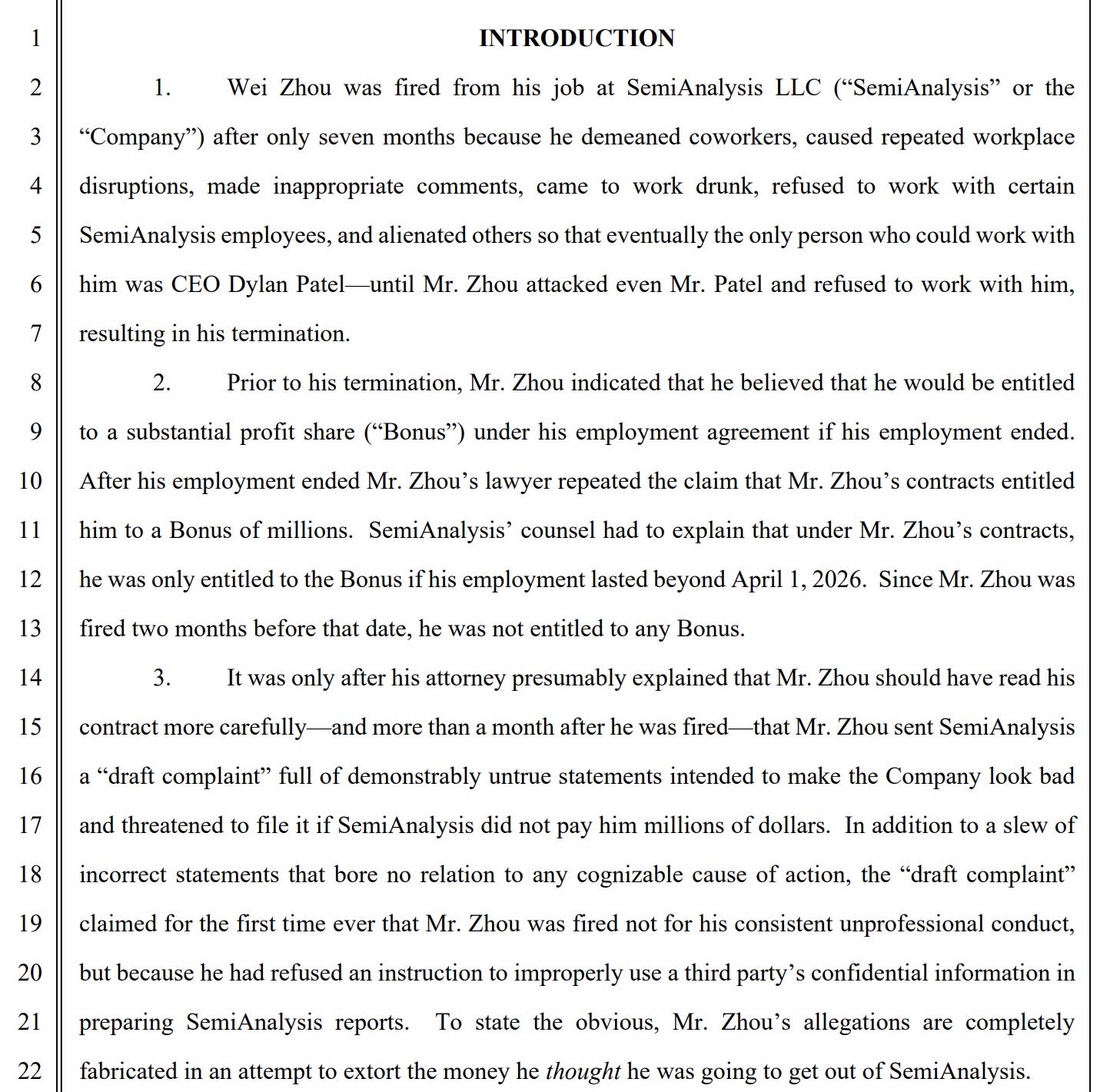
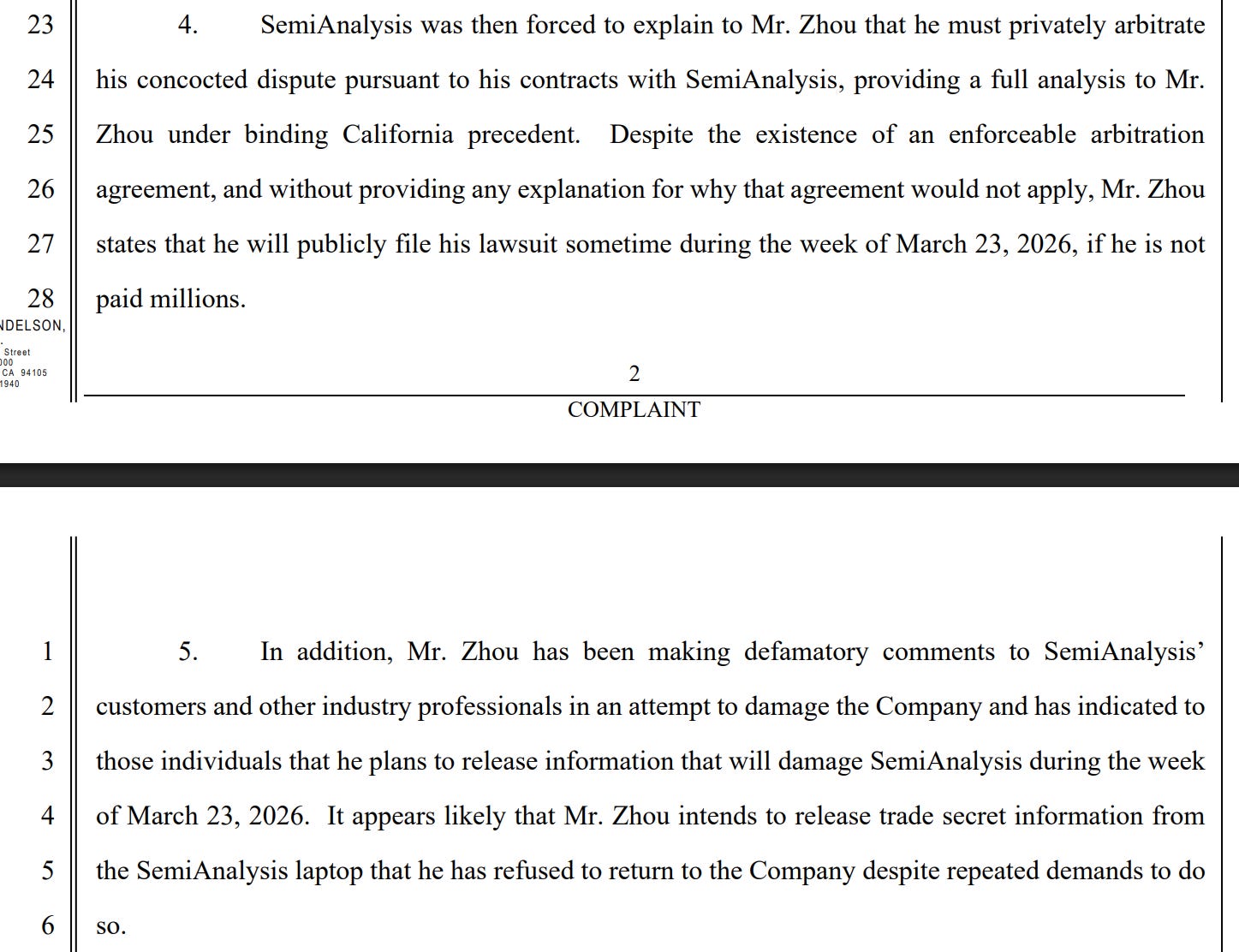
The complaint is longer than the original filing, so I won’t go through it all here. It does have a lot more spicy language, claiming to quote direct messaging between Zhou, Patel, and other employees both privately and in company slack channels.
The complaint doesn’t address Zhou’s original filing regarding MNPI, rather turning the tables and stating it was Zhou’s personal conduct that was at issue. I am in no way a lawyer, but use of MNPI in models does bring up a number of red flags that will have to be addressed either way.
Some Background
I’ve known Dylan for a good number of years, despite him being more than 10 years my junior. Before he started SemiAnalysis he was a moderator on a popular forum where my content was shared frequently – he grew up reading my hardware analysis. After college and moving into the world of semis, Dylan and I have had many conversations and dinners over the years at events.
While we’ve never worked together in any formal financial capacity, Dylan has appeared on my YouTube channel a couple of times, causing some amount of distress for certain Analyst Relations people.
Dylan and I still sync a couple of times a year, at events and such, usually to talk a bit of shop but usually in a very casual way. If anything these days, I’m asking how how business is run, and it’s always changing every time I ask.
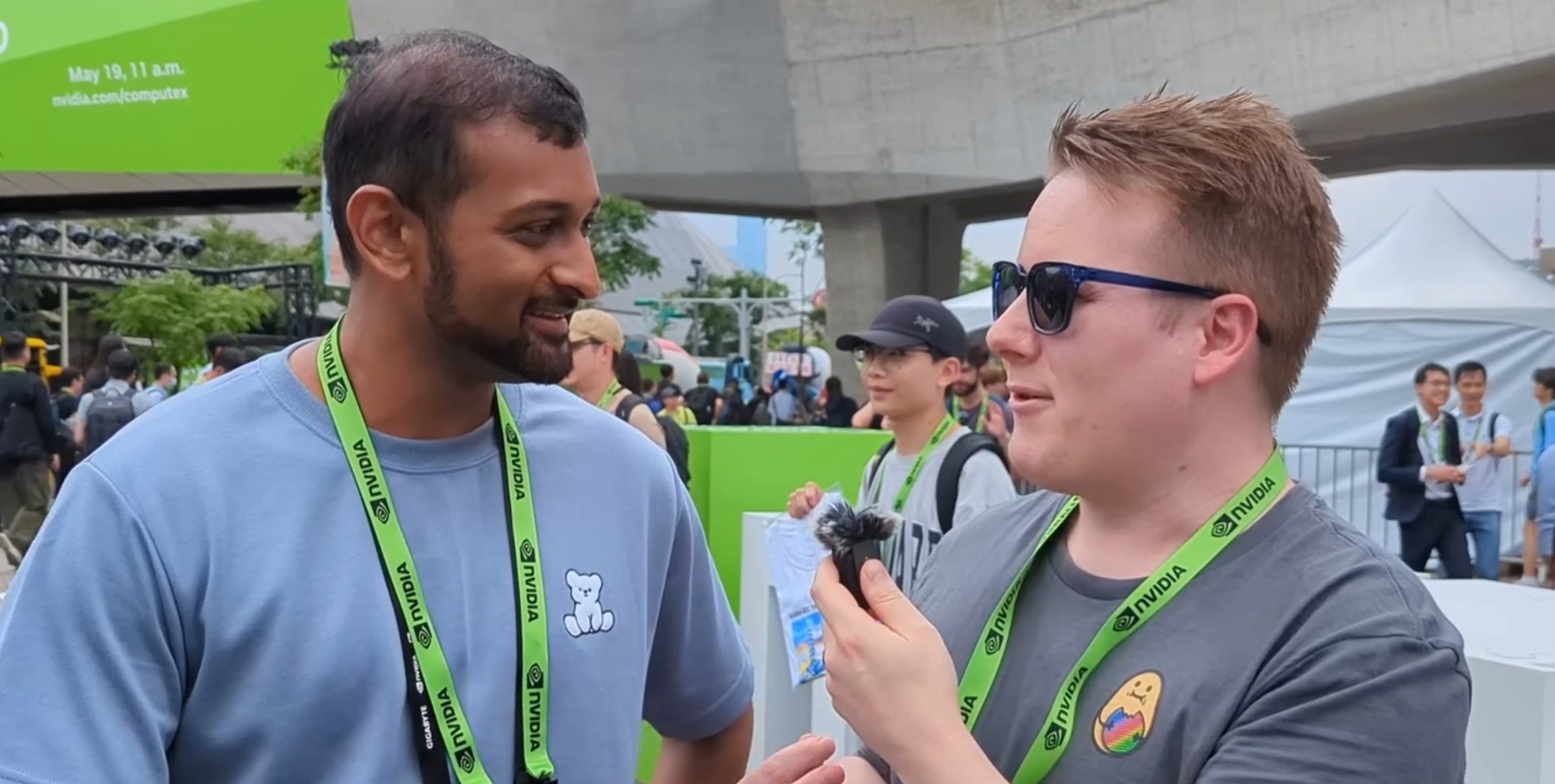
By contrast, I’ve only know Wei for a year or so, and only through his work at SemiAnalysis. But we’ve had dinners a couple of times, and in recent months we’ve spoken more often than I speak to Dylan. He’s a smart dude, I can tell. Even then, our conversations are still more about general industry things and memes than anything else.
I don’t really have an ending for this. Like you all, I’m going to keep abreast of the highlights over the minutiae, but it will be interesting to see where this ends up and if it sets a precedent if it isn’t settled out of court.
And on a personal note, I want to thank everyone that has signed up and remained signed up over the last couple of months. I’ve had a fair amount of travel of late, but I’ve also had some significant family life adjustments as well taking my time and my mental health. It has kept me from posting as much as I’ve wanted. We’re coming up to the financial season again, so I’m hoping to publish a number of pieces on the quarterlies.
I also now have writing some articles for me – he has some contributions in the pipes (some of which are late due to my availability to edit) but I hope you’ll enjoy those as much as my writing as well.
