
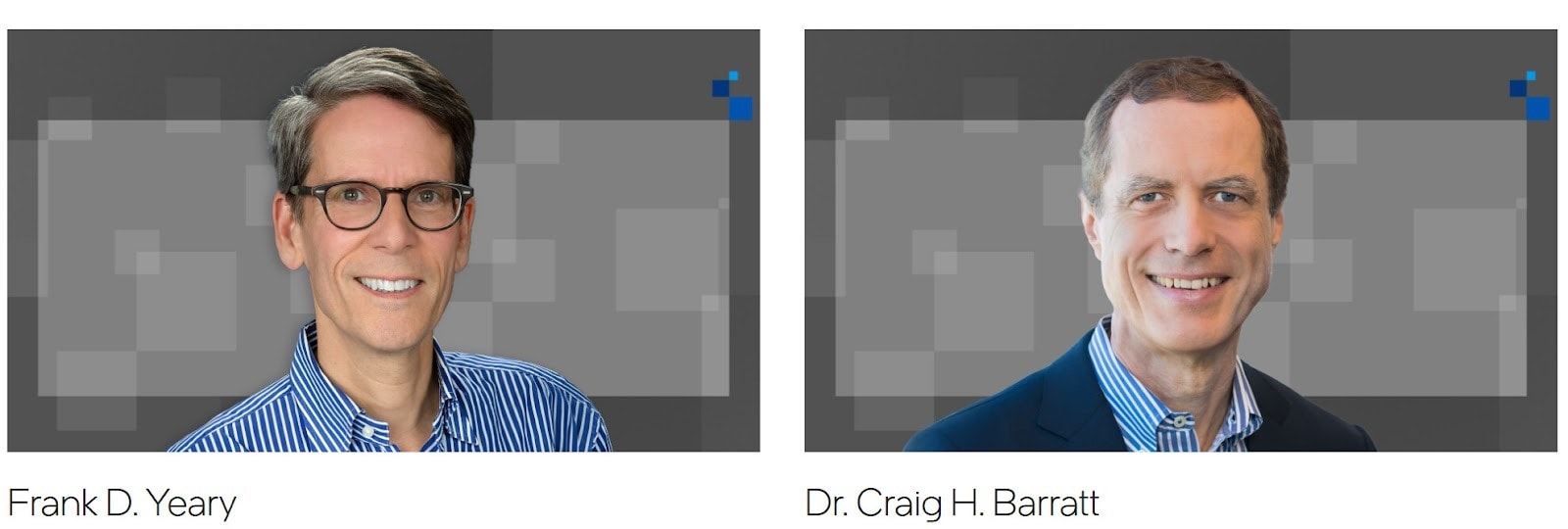
On Tuesday, Intel announced that Board Chair, Frank D. Yeary, is stepping down on May 13th. Dr. Craig H. Barratt (not to be confused with former Intel CEO Dr. Craig R. Barrett), who is the former CEO of Atheros Communications and an Intel board member since November 2025, is set to take over the role at the Annual Stockholders Meeting. Yeary has been on the board since 2009 and has held the chair since 2023. Intel’s board will reduce by one as a result.
Per Intel’s own 8-K filing, Dylan Martin, a senior editor at CRN, outlined that Yeary had informed the board of his plans to retire the Friday previous, so while the announcement by Intel is the public confirmation, this has been in motion for at least a week. Yeary has spent 17 years on the board, and has sat on the top step across some of the most difficult stretches Intel has had to navigate in its modern history. Stepping back now, with the company in the middle of a genuine reset, is a significant moment. Investors privately have been discussing the composition of the Intel Board, and are generally approving of this change.
Barratt only landed on Intel’s board as an independent director in November 2025, so getting the chair role this quickly is fast by any reasonable measure, but his background makes it easy enough to see why Intel felt comfortable moving at that pace. He ran Atheros Communications as president and CEO for eight years, from 2003 to 2011, taking it through its IPO and then its acquisition by Qualcomm, staying on afterwards as president of Qualcomm Atheros before eventually moving on to something different. That something different turned out to be Google, where from 2013 to 2017 he was a senior vice president running Google Fiber and a wider set of internet access and energy infrastructure projects, the kind of operational scale and organisational complexity that the chip industry on its own rarely produces.
After Google, Barefoot Networks came along, where he was CEO of a networking semiconductor company doing genuinely interesting work on programmable switch silicon, right up until Intel acquired it in 2019. He left Intel less than a year after that acquisition, which is worth knowing, and Intel later killed off Barefoot’s Tofino network switch business altogether, which makes his return to Intel in a governance capacity one of the more quietly interesting subplots of today’s announcement. He currently serves as Lead Independent Director at Intuitive Surgical and sits on the board at Astera Labs.
Intel’s CEO Lip-Bu Tan made a statement about the transition, calling out Barratt’s “deep semiconductor expertise and a strong record of technology and operational leadership in complex, engineering-driven businesses.”
Dr. Craig H. Barratt, Intel’s new Chairman of the Board, joins on May 13th
It is worth being straight about what a board chair appointment can and cannot do. Appointing Dr. Barratt does not solve all ills, it doesn’t fix a process node, or close a deal. It does not accelerate a tape-out or pivot the company. What it does do is send a signal, and right now, Intel needs to be sending the right signals to several different audiences at once.
The company is showcasing that the Intel 18A family of nodes (18A, 18A-P, 18A-PT) are set to perform well enough in yield and parametric yield, then in customer silicon, to demonstrate that the foundry business as an IDM is real and not just a strategic aspiration. External customers are currently probing Intel’s ability to deliver on technical specifications and volume production – it is expected that Dr. Barratt can speak the technical language to Intel’s engineers, customers, and investors simultaneously, and having someone with Barratt’s specific technical and operational credentials sitting visibly at the top of the governance structure is part of how Intel constructs that argument.
It also fits a pattern that has been building over time. Intel has added four new independent directors since 2024, and reduced the board overall, as part of what it describes as a deliberate board refresh, and each addition has tilted toward operational and technical backgrounds over purely financial ones. Under Lip-Bu Tan, Intel is trying to reorient itself back toward being a company at the head of the competition.
Yeary’s departure, for its part, is being framed by Intel as a natural transition point, now that the financial stabilisation work of the past couple of years has largely been completed and a clearer technology roadmap is in place. That framing may be accurate, but what is also true is that Yeary has been through some genuinely difficult years, with criticism as well, and the company is now in a different phase, one that arguably needs a different kind of oversight at the top.
The new chairman of the board, Craig H. Barratt, formally takes the chair on May 13th. The real measure of this period in Intel’s history will come when 18A yield data and external customer commitments start becoming visible to the outside world. No board restructuring changes this, but Intel is at least putting people in places for what it is trying to do next.
Intel’s Board currently stands as (with current/former companies noted):
-
Craig H. Barratt: Barefoot Networks, Google Fiber, Atheros
-
James (Jim) J. Goetz: Sequoia Capital (VC), Palo Alto Networks
-
Andrea Goldsmith: Professor of ECE at Princeton, Quantenna, Medtronic
-
Alyssa Henry: Square CEO, Amazon, Microsoft
-
Eric Meurice: ASML CEO, Dell, Arm, NXP, Soitec
-
Barbara G. Novick: Blackrock Co-Founder
-
Steve Sanghi: Microchip CEO, Waferscale Integration, Mellanox
-
Gregory D. Smith: Boeing CFO, American Airlines
-
Stacy J. Smith: Former Intel CFO, Audodesk, Wolfspeed
-
Lip-Bu Tan: Intel CEO, Walden International
-
Dion Weisler: HP CEO, Thermo Fisher Scientific
-
Frank D. Yeary: Darwin Capital Advices, Paypal
