

FEATURES:
– Ossuary jars
– Anti-revolutionary painting
– Toxic dust
– Solastalgia
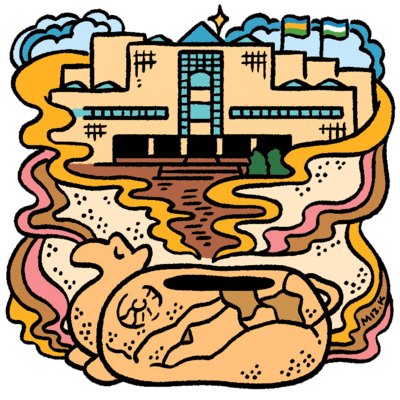
I was a cold, dry night in April, and a crowd had gathered in the center of Nukus, the capital of the Central Asian Republic of Karakalpakstan, to squint through a skein of toxic dust into the illuminated lobby of one of the world’s most peculiar cultural institutions: the Nukus Museum of Art.
The dust storm had started earlier that day, staining the sky a sallow, hostile brown as a hard wind blew south across the Kazakh Steppe and over the Aralkum, a desert that used to be a sea. Until the 1960s, the Aral Sea, split between Kazakhstan and Karakalpakstan—a semiautonomous region within Uzbekistan—was the world’s fourth-largest inland body of water. Fishing, canning, and beaver-fur industries thrived along its reed-fringed coast, drawing a mixed population of Russians, Kazakhs, Karakalpaks, and Uzbeks to port cities like Moynaq, where they settled in tidy whitewashed houses packed along the shore. By the 1990s, the Aral Sea had shrunk by 90 percent, thanks to Soviet irrigation projects that siphoned water off the Amu Darya river to feed the cotton fields that sprawled across Uzbekistan. As the sea retreated, it left an empty wasteland, frosted in a white rime of agrochemicals and salt that turned the air and soil to poison. Respiratory illnesses proliferated across Karakalpakstan. Temperatures became increasingly extreme, ranging from 10 degrees Fahrenheit in winter to 110 in summer. Water has grown scarce, and arable land has turned to desert.
If Karakalpakstan is known for anything—and in most places, it isn’t—it is for this singular man-made cataclysm. If it’s known for two things, the other is the Nukus Museum, which grew as the Aral Sea shrank. The museum was founded in 1966 by the Kiev-born artist and collector Igor Savitsky, who first came to Karakalpakstan to record the archaeological finds of the legendary Chorasmian Expedition. As a motley crew of intellectuals, local laborers, and refugees from the Stalinist terror—led by the mustachioed and pith-helmeted ethnographer Sergey Tolstov—dug two-thousand-year-old ruins out of the sand, Savitsky captured their discoveries in voluptuous (if sentimental) pastels, rendering austere mud-brick fortresses in delicate shades of peach and salmon. By the mid-’50s, Savitsky had settled permanently in Nukus as a member of the local branch of the Academy of Sciences of the Republic of Uzbekistan. He spent the next decade collecting textiles, jewelry, and carved wooden trunks that Karakalpak people in hamlets across the region had hidden away in the early years of collectivization; villagers knew him, affectionately, as “the junkman.”
Eventually, he approached the first secretary of the Karakalpak Regional Committee of the Communist Party, Kalibek Kamalov, with the idea of opening a museum. Kamalov, a proud Karakalpak, loved the idea. For him, the museum would establish a clear material identity for the Karakalpak people. And though Moscow had long suppressed craft as an entrepreneurial heresy, Savitsky’s ethnographic collection, pitched the right way, aligned with the official Soviet ideology known as “the friendship of peoples,” which positioned the USSR not as a latter-day Rome but as a multiethnic consortium of nations—a counterweight to the cavalier economic domination of the postwar United States and faltering European colonialism. Think of it as a Soviet “It’s a Small World (After All).” (The US and the USSR were never quite as different as they liked to think.)
This proved a useful cover for Savitsky, as he turned his attention to avant-garde painting, which was essentially verboten in Moscow. From 1966 until his death in 1984, he amassed tens of thousands of paintings, coaxing rolled-up canvases from beneath the cots of ailing widows and withdrawing others from the confines of the Zagorsk Monastery in Russia, a kind of gulag for art that was deemed anti-revolutionary. In the process, he conserved an epoch in art history that Soviet authorities aimed to purge from the official record. The avant-garde collection is now justifiably famous. Foreign journalists love to write about it, and in 2024, the Uzbekistan Art and Culture Development Foundation (ACDF) took some of the collection’s major works on tour in Florence and Venice—a cultural coup.
But when I arrived in Nukus, I was even more interested in the museum’s silver jewelry and quilted robes, and the bands of embroidered cloth used to decorate yurts. I wanted to see the artifacts of a way of life that the Soviet Union had attempted to destroy in the name of its misguided, utopianist faith in technological progress. (Sounds familiar.) What had been lost? What had been saved? What could still be recovered? I was, of course, far from the only person asking these questions. The directors of the museum’s archaeology and ethnography departments (Oktyabr Dospanov and Aygul Pirnazarova, respectively) told me that, in recent years, more and more young people—jewelry and clothing designers, as well as college-aged kids studying in the Uzbek capital of Tashkent—have used its collections for inspiration.
That pride is no small thing. In June 2022, shortly after his reelection to a second term in office, the Uzbek president, Shavkat Mirziyoyev—lauded abroad for liberalizing his nation’s economy—proposed a series of constitutional reforms that would allow him to remain in power until 2040 (ratified in 2023) and that would strip Karakalpakstan of its nominal autonomy. Mirziyoyev’s play to extend his term barely raised eyebrows, but his attack on Karakalpakstan’s political status triggered widespread protests in Nukus and brutal reprisals from the state, which shut down internet access, jailed activists, killed several protesters, and wounded many others. Young people led the movement, as young people are wont to do, and within a few days, Mirziyoyev withdrew the proposal, even traveling to Karakalpakstan to present himself as a humble broker of peace. Several activists remain in prison. Savitsky’s original argument, meanwhile, seems more urgent than ever: The Karakalpak people exist, they have a language and culture, they have a homeland, and it is here.
And so on that night in April, I joined a crowd of Karakalpak students, foreign architects, regional scientists, and culture workers from across Central Asia to file into the Nukus Museum, where the ACDF was to unveil a significant rehanging of its top floor. The event coincided with the beginning of the tourist season, to the extent that such a thing exists here, and with the end of the Aral Culture Summit, a conference organized by the ACDF about the future of Karakalpakstan and the Aral Sea region. Over the course of the previous two days, agronomists and biologists had spoken of efforts to reforest the Aral seabed with hearty saxaul shrubs and to introduce salt- and drought-resistant crops. Artists had discussed their dreams, fantastical and hopeful and sad, of the sea’s return. On the first day of the summit, when foreign speakers graced the stage, the ACDF hosted a gala lunch prepared by a Russian chefs’ collective using Karakalpak ingredients; in the evening, a Russian pianist played his own compositions with the National Symphony Orchestra of Uzbekistan, which had been flown in from Tashkent, more than five hundred miles to the east. (The kobyz, a Karakalpak string instrument at imminent risk of disappearing from the region’s musical culture, was nowhere to be seen.) The next day, the audience filled with Karakalpaks, sitting rapt as their peers and elders explained all the ways their home could be saved. For lunch, they waited in an interminable line to scoop overcooked lamb and root vegetables from chafing dishes. Throughout the event, young people from Nukus circulated among the invitees, engaged and warm and thrilled to talk about their homeland—its beauty, its tragedy, its possibilities. Fluent in English, almost all of them planned to leave as soon as possible, to study in places where the wind didn’t make the air smell like sickness, where there might someday be work and water.
When the doors finally opened at the museum, foreign visitors went in first, locals second. I lingered inside as most of the other foreigners filed out, to catch their planes back to Tashkent. The museum was a revelation. Works by painters whose names I’d never heard of depicted Uzbek grazing lands in improbable shades of pink and blue. There were images of men gathering in poppy-red tearooms, seated cross-legged beneath interpolated portraits of Lenin and startlingly anachronistic megaphones—symbols, like Gabriel’s lily, of a new and hopeful annunciation. Between the canvases hung elaborate quilted robes lined with silk ikat, and silver amulets encrusted with roundels of carnelian, cloudy and lustrous as crystallized honey.
As the galleries emptied, the same young people I’d met at the summit hung back. Instead of inspecting the paintings for traces of their own lost landscape, they gathered around a Zoroastrian ossuary jar in the shape of camel, and a long band of wool, framed behind glass, used a century back to decorate a yurt. They gazed up, as stunned and awed as I was, at its narrow surface, covered in delicate abstractions of camels’ feet and rams’ horns, and of water that had stopped flowing before they were born.
Read more essays, reviews, and interviews over at The Believer.
